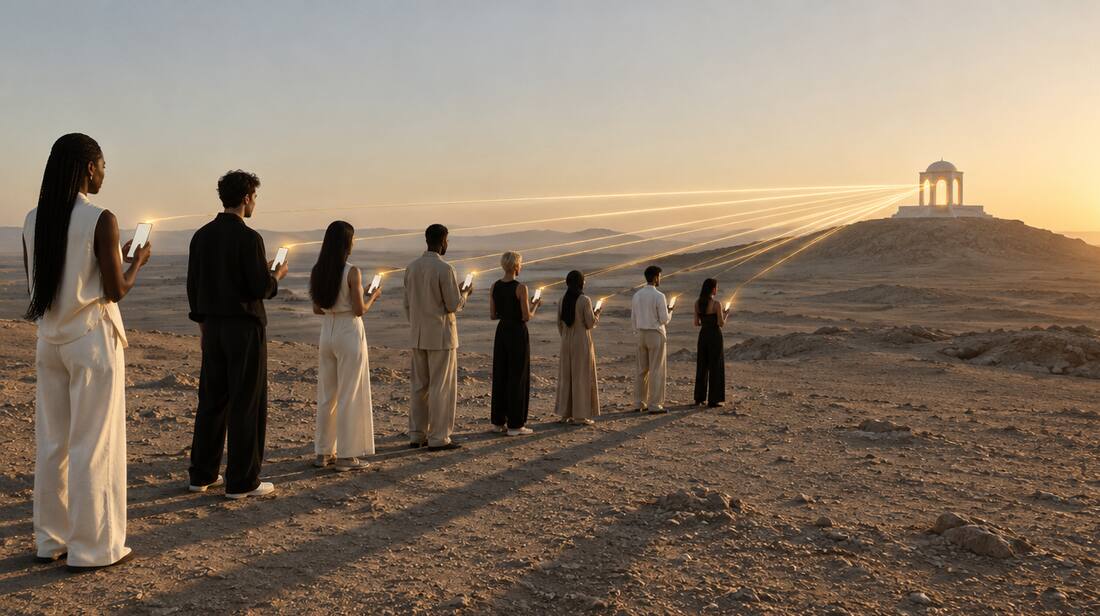
For most of history, a community began with a place. You were born somewhere, and the people around you became your people. The internet reversed the order. Now people find each other first, around an idea, a passion or a set of values, and only later ask the question: where should we meet?
The network state is the most ambitious answer to that question.
The idea in one paragraph
The term was popularised by entrepreneur Balaji Srinivasan, who first used it in 2015 and published The Network State in 2022. His argument: a strongly aligned online community could raise money together, acquire physical territory around the world, link those territories digitally, and eventually seek recognition as a new kind of state. First a community, then a startup society, then a network of real places.
A network can raise capital in an afternoon. It cannot raise attachment that fast.
You do not have to agree with the end goal to see the power of the first steps. Online communities already organise, fund and coordinate at a scale no village ever could. The open question is what they build when they reach the ground.
From theory to test sites
The idea has moved fast from book to experiment. Srinivasan founded the Network School in 2024, first on an island near Singapore; in 2026, after Malaysian authorities ordered it to stop operating there, it moved to Kazakhstan under a five-year agreement that includes a new campus and an annual Network State conference. Around the world, smaller groups test co-living villages, digital-nomad hubs and community-owned land.
Most of these experiments share a pattern: brilliant at governance tools, payments and online coordination; much weaker at the thing that makes people stay in a place: beauty, meaning and culture.
Code is not enough
Ask why people love Venice, Kyoto or a small Georgian hill town, and nobody answers "efficient governance". They answer with light on water, a square at dusk, the feeling of standing where centuries of people stood.
A network can raise capital in an afternoon. It cannot raise attachment that fast. Attachment comes from shared stories and shared places, and it grows when people make something together.
That is the gap we see in the network-state conversation, and where we work.
A cultural route to the same destination
Love Creators World is not a network state. We do not issue passports or seek recognition. But we share one belief with that movement: online communities can, and should, shape the physical world.
Our route runs through culture:
- The community forms around a place, not an ideology. A forgotten building or landscape gives thousands of strangers a shared object of care.
- Creativity sets the agenda. Creators propose futures for the place; the public votes and follows.
- Capital follows the story, through patrons, partners and, increasingly, new tools such as tokenized participation.
- The result is open to everyone, not just members: a museum, a square, a public hall.
If network states are about building new countries, we are about something smaller and perhaps more urgent: giving existing places a second life, with the help of a global community that cares about them.
Questions worth asking
The network-state idea raises real questions that any serious project should face:
- Who belongs? A place transformed by a global community must still belong to the people who live there.
- Who decides? Online voting is powerful, but the curatorial framework and local voices must shape the brief.
- Who benefits? Transparent rules on how value is shared matter more than any technology.
We will return to these questions in this journal, because the answers will decide whether the bridge between the online and physical worlds builds communities or simply buys land.
Next: how tokenization could let thousands of people co-fund the restoration of a single building.