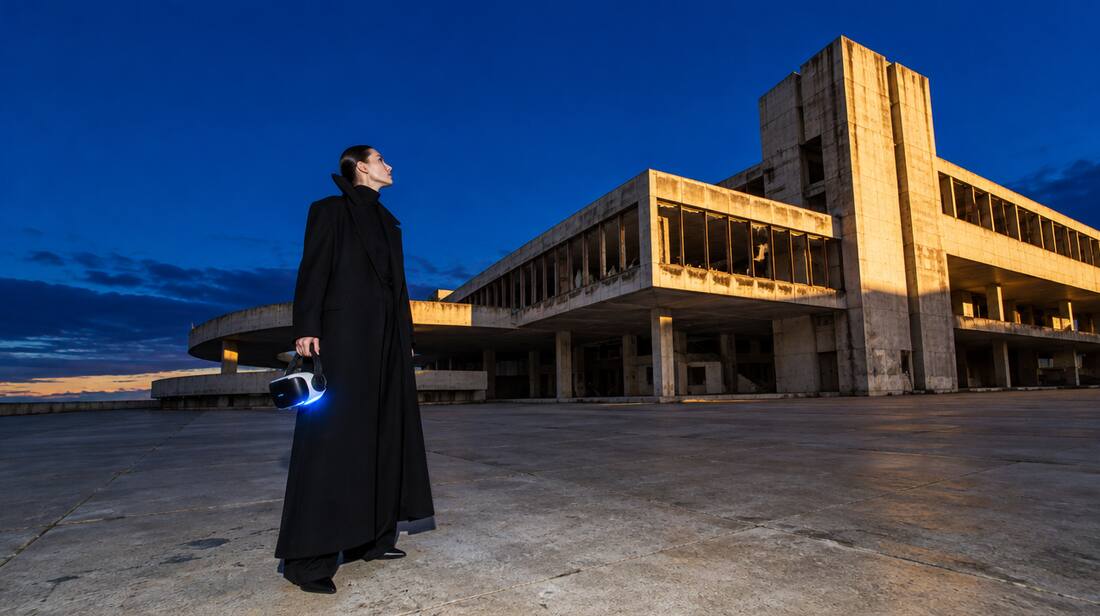
In October 2021 a social network changed its name to Meta and told the world where the future would happen: inside a headset. Five years later, the division building that future, Reality Labs, has lost roughly $88 billion since the end of 2020, including $4.6 billion in the second quarter of 2026 alone.
It is easy to read that number as a story about a company. We read it as a story about direction.
For two decades the internet's grand ambition has been to pull more of life into the screen: more hours, more identity, more money, more land, even if the land was made of pixels. Virtual plots sold for the price of real apartments. Avatars got wardrobes. And the most interesting question was never asked: what if the movement should go the other way?
The next internet is not somewhere else. It is here, and it is physical.
The internet is very good at one thing
Strip away the hype and the network does a few things better than anything humans have built. It gathers attention at planetary scale. It lets strangers who share a passion find each other in minutes. It lets millions of people vote, comment, fund and decide together.
What it does badly is make anything last in the physical world. A trending post fades in a day. A virtual world empties the moment its servers cost too much. The energy is enormous, and almost none of it lands anywhere you can stand.
Meanwhile, in almost every city on earth, there is a building nobody has opened in thirty years. A silo on a waterfront. A cinema with its seats still bolted down. A hill above a town with a view nobody can reach. Real places, waiting, with no attention and no capital pointed at them.
Put those two facts next to each other and the gap is obvious.
From a virtual world to a world made real
Love Creators World starts from a simple bet: the next internet is not somewhere else. It is here, and it is physical.
Instead of building a digital world for people to move into, we use digital tools to change the world people already live in. The game happens online. The result is a renovated building, a new public square, a cultural route through thirteen villages.
The mechanics are deliberately familiar to anyone who has played, voted or crowdfunded online:
- A real place enters the game. A forgotten building, landscape or waterfront is chosen and opened to the world.
- A curatorial framework sets the brief. What the place was, what it could mean, what its community needs.
- Creators answer the challenge with visions for its future.
- The public participates: watching, voting, joining teams.
- The process becomes a global show, followed the way people follow a competition.
- Capital follows attention. Patrons, partners and new financial tools fund the winning vision.
- The place is transformed, in concrete, glass, light and life.
Every step uses the internet for what it is good at. The final step is something the internet has never been able to do on its own.
Why "phygital" is the wrong word, and the right idea
Marketers call the blend of physical and digital phygital: a QR code in a shop window, a digital twin of a store. It is a useful word for a small idea.
The bigger idea is that online communities can now act as clients of the physical world. Thousands of people in different countries can commission, shape and co-own the future of a place, then visit it, work in it and see their names on its walls. That is not a digital layer over reality. It is reality, directed by a network.
Thinkers have circled this for years. Balaji Srinivasan's The Network State imagines online communities crowdfunding territory. Civic crowdfunding platforms have paid for parks and bridges. Heritage foundations rescue buildings one donation at a time. Each piece exists. What has been missing is a single, joyful, public game that joins them: attention, creativity, capital and a real address.
Beauty is infrastructure
There is a reason we start with forgotten places rather than empty land. A building that has stood for a century carries memory, and memory is what makes people care. When a community watches its abandoned silo turn into a museum of light, it does not experience "development". It experiences a story, and it wants to be in it.
That is why we say beauty is infrastructure. Roads move goods; beautiful, meaningful places move people. They attract talent, visitors and investment, and they make a town feel like a future rather than a leftover.
What comes next
The metaverse promised a second world. We think one is enough, as long as we are allowed to rebuild it together.
In this journal we will write about the forces that make that possible: the creative economy, network communities, tokenization of real assets, cultural crowdfunding and the art of renovating what others forgot. And we will report from the places themselves, as they enter the game.
The future is not a spectator sport. Find your role →