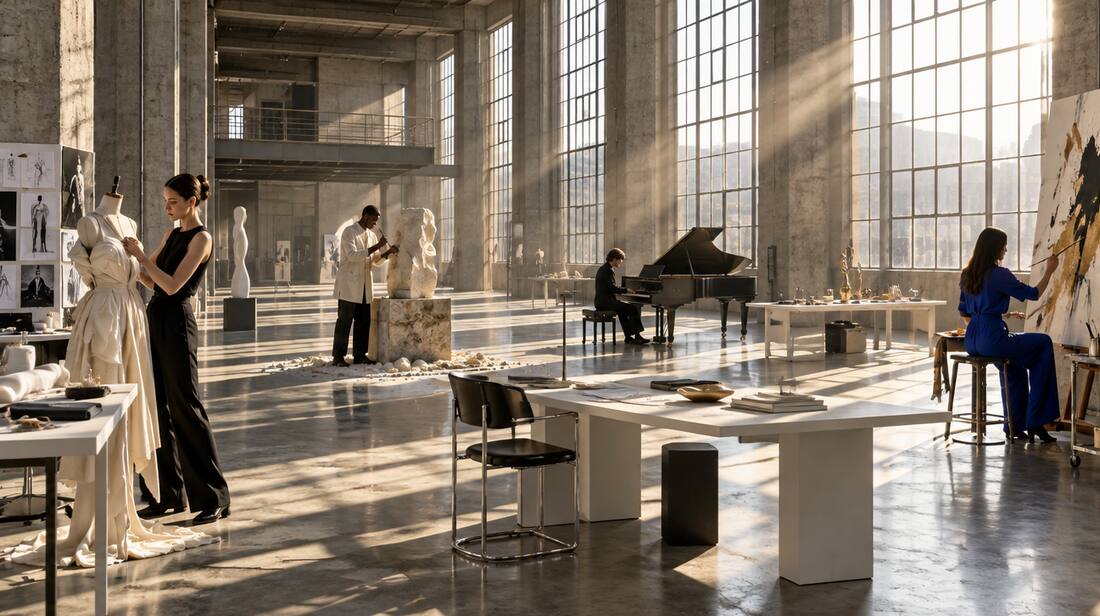
Ask ten people what the creative economy is and you will get ten answers: film, fashion, video games, architecture, festivals, design studios, influencers. All of them are right. The creative economy is the part of the economy where the main raw material is imagination, and its main product is meaning: things people want because of what they make them feel, think or belong to.
How big is it?
Bigger than most people assume, and growing faster than trade overall.
According to UNCTAD's Creative Economy Outlook 2024, world exports of creative services reached $1.4 trillion in 2022, up 29% since 2017, while exports of creative goods reached $713 billion. Depending on the country, the creative economy accounts for between 0.5% and 7.3% of GDP and employs up to 12.5% of the workforce.
We turn creative attention into creative infrastructure.
Governments have noticed. In Russia, creative industries made up 4.1% of GDP by 2024 results, with an official goal of 6% by 2030 and a sector strategy through 2036. Uzbekistan, the UAE, South Korea and the UK all run national creative economy programmes.
What counts as "creative"?
Definitions vary, but most frameworks include:
- Heritage and culture: museums, historic sites, crafts, festivals
- Arts: visual and performing arts, music
- Media: publishing, film, television, games, digital content
- Functional creations: architecture, design, fashion, advertising, software with a strong creative core
What unites them is that value comes from ideas and experience rather than from volume of material. A chair and a design icon use the same wood.
The missing piece: place
For all its growth, the creative economy has a strange blind spot. Most of its value now lives online: streams, files, platforms, followers. Creators are more connected than ever and more placeless than ever.
Yet the most powerful creative projects in history were rooted somewhere. The Bauhaus was a school in a building. Montmartre was a hill. Every thriving creative district, from Shoreditch to Kreuzberg to Moscow's Winzavod, began with an abandoned or overlooked place that creative people made meaningful again.
That is the cycle we want to accelerate: creative energy, pointed at real places, at global scale.
How the creative economy changes places
When creativity lands in a physical place, the effects are measurable and they compound:
- Old buildings get new uses. Factories become galleries; warehouses become studios; silos become museums.
- Visitors follow meaning. Cultural tourism rewards places with a story worth travelling for.
- Talent stays. Young people stay in towns that feel like a future, not a leftover.
- Investment follows attention. Once a place is loved, financing its next chapter becomes easier.
The risk is equally real: when only the price of land rises, local communities can be pushed out. That is why we believe transformation must be designed with a community, not to it, which is why every place in our game begins with a curatorial framework and public participation.
Where Love Creators World fits
We treat the creative economy as an engine and real places as its destination. A forgotten building enters the game; creators from anywhere answer its brief; the public votes and follows; capital funds the winning vision; and the place opens again, this time as part of the global creative economy rather than outside it.
In other words: we turn creative attention into creative infrastructure.
Key terms
Creative economy: the economic activity built on creativity, culture, knowledge and intellectual property. Creative industries: the sectors inside it, such as design, media, arts and heritage. Креативная экономика / креативные индустрии: the Russian terms, now used in national policy. Adaptive reuse: giving an old building a new purpose without demolishing it.
Next in the journal: what network states are, and why they will need real places. Read the manifesto →